Friday, 13 January 2023

Day 8: Bouncy, Bouncy Trails & High Camps

Started the day in the wet and grey, finished in the same. Apart from about two hours in the middle, it hasn't stopped crap weather all day long. At least it's warm! I seem to have left the Eucalyptus forest behind and moved more into the pine. A bit like Wales or Scotland really. The trails have been rougher today, lots of heavily washed out sections, still plenty of climbs, but less steep downs. I've also came across a few downed trees across the trail and several sections that have sloughed off the road banks and almost blocking the route. Bikes can get through, but they'll need sorting before wider vehicles can continue. The trees added some fun for the most part, apart from one section where two bigger ones were across the route. I tried to find a way around, but everything dead ended, so in the end I had to turn around and use some tarmac. This allowed me to source fuel as well at Cortegada, near the Portuguese border. 

Once back of the TET, I came across two old ladies walking their tiny little dog, soon after a tree was down, I took a detour up a bank to get around it and was just spinning the back wheel on a big tree when they caught me up and offered to help. They both had soft little nice shoes on and although I'm sure they were strong as, I just said things were buenos and they moved on. I rolled the bike back to the track and moved the offending tree, then as I was about to get on, they popped their heads back around the corner and asked if I was sure? I said a smiley thankyou and popped up the bank and rode by them shouting 'Mucho Gracias' and 'Ciao' as I rode off. 

I lost my top bag on one of the really rough hill climbs today. The stitching on the £32 bag just couldn't cope and ripped the bottom strap clean off. This slackened everything else and off it all tumbled. I found out when I hit a big hole and had to jump off the bike to save it, noticing a distinct lack weight as I did. The fuel bladder was about 300m down hill, the main bag about 600m. What a slog to get back to the bike, I was hot and dehydrated again, so at the next village, there was a beautiful granite source with two big washing troughs, so I sat under the shelter and drank a load of water whilst munching on almonds and appreciating the craftsmanship that had gone into building that source. 


My camp for the night was under some large granite boulders high up on a hillside. It was better sheltered but still really windy and the rain was lashing down on the tent again. We'll see what tomorrow brings. I'm skimming along above Portugal at the moment, meandering towards the final part opf the northern Spanish TET. I thought I might finish it today, but it'll be tomorrow now. I'm fed up with this wind and rain, its like being back home. At least the trails are engaging.  

Day 7: Bushwacking

I left the hotel in Santiago just as the sun came up. Their heating bill will be higher for my room as I whacked it up all night making sure all my kit was dry. Good practice for the Sahara! Time seems to have changed a bit since I started this trip, I never know what day or time it is. It's either food time, fuel time or riding time with once a day, sleep time!!

Having spent some time looking at the route last night, I'd decided to head to Padron, SW of Santiago. The road down there was really busy, after days of no traffic, it was a bit of a shock to the system to suddenly have to think about others on the road again. A full tank of fuel and another cafe con leche down my neck and it was off onto the trails again. 

This area is made up of white and pink granite. Plus points, it dries quickly and drains well, downside, on steep gradients there are marble of crystals everywhere, so no hard braking and keep and eye out for the regular side cuts draining the excess water off the hillsides.

During the morning, the trails were all easy, flowing and climbed up and down rolling hills or dodged down little back streets in villages. As the day wore on, the trails got rougher, with a few requiring real concentration with the deep water cut channels and rock strewn everywhere. All of the day wound through either Eucalyptus forest or vineyards. The smell of the Eucalyptus was lovely after all the rain. The trail wound back towards the coast and followed this, towards late afternoon it turned eastwards and started to run adjacent to the Portuguese border. I suspect I'll cross this tomorrow now.


My camp for the night was more a lack of choice than anything else, tucked in a small firebreak just off the route. I'd passed loads of good places with water, tables etc, but as usual, I thought I could get a bit farther, so carried on! At one point during the day, I made a nav error and rather than turn around, I thought I could take a short cut and rejoin off an old section of forestry piste. That was a mistake. The track narrowed up and I found myself in an awkward place where I couldn't turn around and everything below me was thick fallen trees. I decided to unload the bike, then get it over the next log as there was an obvious way down from there. It didn't go to plan, the bike ended up facing uphill above a hole, no traction and a big boulder which sucked the bike right between it and a tree. Hey ho, Climb underneath it, lift the back wheel and lower it down. It was nearly there, when the bike decided to just drop onto the back wheel, tumble backwards over itself and land upside down. Oh well, it was down! Next, get it through the bracken and bramble back to the track below. Lots of sweating, kicking trapped bramble and good old 690 was back in a rideable place. 

I took the trail back up to the same height as the dumped luggage, then retrieved that lot, had a dunk in the river as I was poring in sweat by now, then reloaded the bike and off I went again. (Note to self: Turn around earlier and don't get into that again!!). The bike was typical KTM. Get it back on its wheels, check it over and start it back up ready to go again! 

I do need to straighten the rally screen though as two of its brackets have bent.

Sunday, 8 January 2023

Day 6: Washed Out to Sea...

It has belted down all day, sometimes heavy, sometimes light, but not really stopped except for 10 minutes at a great stopping point. I've taken two photos all day. 

The bike was all loaded by a very lazy 10am. I had deliberated about staying where I was, but decided that wasn't acceptable at all, so brushed off my absolute dislike of being cold and soaked and set off into the grey cold and miserable day.

Overnight heavy rain and high winds have started to cause a lot of flooding here, the rivers are over their banks and the fields and in one case, a whole playground, was under water. I  gave the TET route a nod, but that was about it. Tarmac all day long, well almost!

First to Lugo, 120km away from Ponteferrada, (where I'd spent last night). I was soaked through to my undies with no waterproof trousers and getting really cold, so a coffee and some Tortilla in a nice warm cafe seemed to do the trick and I set off again to Santiago De Compostela, roughly the same distance again. Same thing, really wet and cold. The rain showers seemed heavier and more prolonged on this leg. As I zipped past on the motorway, I saw a Decathlon and heading into there with the hope of finding some cheap overtrousers. Much joy and 20 euro lighter and I now have a spangly set of cycling waterproof trousers. I should go faster and look leaner now!

Feeling warmer, especially since I remembered the Adventure Spec waterproof jacket had a hood designed to go under a helmet, how much heat does that keep in! So, my goal finally coalesced in to reaching the most westerly point of Spain, which happened to be 45 miles away. 

No matter how hard I tried to navigate towards it though, I always seemed to be going in the wrong direction. First on a Payage motorway heading south, then winding through villages whose exits always went east or south. Some perseverance saw me get onto the right road at last and I wound down to a lighthouse perched on a little peninsula called Faro Tourinan. 

Ironically, this was the only dry part of the day. The waves were crashing into the rocks and the place felt wild. Sunlight and rain showers danced across that rather angry looking sea and the swell crashed into the granite cliffs underneath the lighthouse. A truly fitting turn around point!

Back to Santiago,  (via a short but fun section of the Camino route), using the Satnav part of the GPS, I should have tried this earlier!. Once back, I rode around for ages trying to find somewhere to stay. You can tell it's the off season. Finally found a 3 star hotel with an underground garage, 36 euros for me, 8 euros for the bike in a heated space no less!

Tomorrow is looking to be the only dry day in the next week, so I'm heading south to Portugal chasing some sunshine and hopefully to get back on the TET. Tarmac is OK to get you to places, but it is a soulless journey.

Anyhoo, here is the pictures! I'm going for a beer now!


Saturday, 7 January 2023

Day 4: Soggy, Soggy, Soggy.

 I hid in the bothy all morning, the weather was cold, very wet and windy. Just like being back in the UK. I used the time to sort out niggling things. I now have a Spain basemap on the GPS. For some reason and despite the laptop and Garmin Basecamp being able to see the maps, the GPS unit couldn't. Swap out the Micro SD card for another with exactly the same files on it and hey presto, I have a map. Stupid electronic faeries playing again!

I also sorted out the cooker, some repairs and found that one of the crashes in the last few days had crushed the plastic tub with all the spare bolts in it. Hey ho.

Around midday, a group of Spanish folk in a 4x4 called by, they told me the forecast was snow above 1600m for the coming night and all the next day, that was enough for me. I decided to drop down from the planned next two days of riding the higher hills and err on the side of caution for once. Having lost my over trousers a couple of days ago had me worrying about hypothermia once I got soaked on my upper thighs, so I duly wrapped up in everything I had and set off down to a tarmac road. 

I ended the day by trying a section of the TET on the lower hills and found it was so slippy and muddy, with some hairy descents between deep washed out ruts surrounded by trees all covered in a beautiful lichen. Again, common sense called out, (I must be getting old!) and I headed to a town, where I booked into a hostal for the night. A hot shower, a shave, some beer and a hot meal seemed a great idea as I was now soaked to my undies again.


Hey ho, we'll see what tomorrow brings and decide from there where to go next!

Day 3: Up and Over to the Bothy

I set off as the sun was changing the sky again, it was pretty cold and there was some ice around, so I picked my way up and down the hills. 


The morning was lots of the same as yesterday, long climbs, long descents, warm and sunny. I stopped at a cafe for some coffee and tortilla, then refueled before heading back up. 


As I moved further west, the terrain changed from the rocky peaks to a more rolling moorland type terrain. This also meant more mud and more villages. These lower heights are where a lot of stock seemed to be as well, so I encountered about 10 of the wired gates. You do have to be looking for those little plastic bags swinging in the wind to see them though! 


Water run off seemed to be greater too, suggesting its wetter along this section. The cold temperatures meant sheet ice, which you can usually bypass on the trails, the tarmac is a bit scary though. 

At one point, I dropped down a fantastic ridge line past an isolated chapel and entered an obvious quarry section. No one was around, so I scooted through to the village below and then back out and up into the lovely deciduous forest above. 

The trail climbed and climbed, it was again getting dark, with the true full moon on show and the fading sunlight highlighting the high ridges across the valley. 

I kept going, with a plan to get to a col and camp there, but luck saw me find a bothy, a really nice one too, with somewhere undercover for the bike as well. 

A local guy turned up on an old AJP dirt bike, neither of us spoke the others language, so with the help of his phone, he asked me if I was planning to use the bothy for the night and then showed me where the wood pile was as it is under cover and wished me a good night. 

A cloud inversion was coming up the valley, lit up by the moonlight, but as the wind was getting up, I heading inside and settled down for the night.

Day 2: Picos to a Ruin!

I pack up and am moving by 7.30am, passing two rangers on their way up the valley. As I descend, I pass a fountain next to a high summer village. It looks like stock and people stay up there for the warm time and descend for the cold season. Although plenty of the buildings need some TLC unfortunately.


The rest of the day is a mix of a bit more tarmac split by loads of superb hill climbs, ridge traverses and long descents. Its warm, sunny and dry, riding through the mountains with no pressures and no need to be at any one place. This is my nirvana. 


There was a little bit more technicality to some of the lanes today, as I joined the main West-East TET route. The forestry section was just like the UK forests, steep, overgrown and route finding was interesting.

Two more falls, one on a short steep uphill, the front just slid out on the bend, the bike went down hard as I was accelerating up the hill, the second was due to tyre pressures being too high for the slippy soft muddy ruts. The bike slid out, leaving the wheels higher than the handle bars, which meant I had to take the top bag off to get it upright. I then promptly slid away from it in the mud and it fell into the thorn bushes! Plenty of swearing, some bush kicking and it was back on its wheels. 
As I was loading the bags back up, two hunting hounds appeared, next there was a shotgun blast and I got sorted super quick after that and rode away!! 


My camp for the night was next to an old ruin, across from a ridge where the moon had just risen and the glow of sunset was just beautiful.


Day 1: Santander to the Picos

The ferry from Portsmouth slid into its berth at Santander around 6am, just as the sun was cresting the horizon, which lit the town up in a lovely light and promised a beautiful sunny day. As I rolled down the ramp, I felt a bit relaxed, considering I'd had next to no sleep on the ferry. When I booked, all the cabins were full, so I took the 'Comfy chair' option, what a joke, those seats were designed by a descendant of the Spanish Inquisition, who was clearly laughing their heads off at every passenger on those ships!

Couple that with several issues which seemed to crop up as I came to start the bike. 1. Couldn't remember where I'd stashed the bike key for safety, so hunt out the spare. 2. GPS had no base map and I couldn't find the torqx key to unlock it. 3. Two phones had no base maps on the app I'd spent ages downloading a week ago. Technology, it's fab when it works, but a dead weight when it doesn't!

I called into a petrol garage with a cafe, used their WIFI to re-download the maps again, one problem resolved, fuel was next and some Euro's. Once all of these were sorted, I followed the purple line on a blank screen on the GPS, which is surprisingly easy when you've used them as much as I have over the years. Right, riding time!

Tarmac roads took me out of Santander to some villages and then into some woodland alongside a river for the first of many lovely trails today. The TET here starts to climb pretty quickly and the lanes get longer and steeper. The views back down to the sea under a deep blue sky settle me into a rhythm of climb, traverse, descend. I saw some fab wildlife as I rode by, a huge vulture, plenty of black kites, a buzzard and lots of the local guard dogs protecting the stock in the hills. 


My first fall of the trip came in the afternoon, a short section full of deep puddles. I cleared them until the last one, which turned out to be deep and have a vertical exit face. The bike stopped dead, I didn't, at least not until I hit the stony surface about 4 foot in front of my bike! A bruised hip, a broken phone case bracket and mud everywhere. (Note to self; go a bit more steady with these puddles than the ones in the UK!!).

I finished the day riding in the dark up and over a pass under some of the main peaks of the Picos. The nearly full moon and clear sky gave a glowing light to everything and the snow on the tops just made things brighter. Good job as there was plenty of ice on the rough surface to avoid. I love riding in the dark in the hills, its a bit scary as you're dependent upon your lights normally and they are limited but on nights like this one, it may as well have been daylight.

Once I'd descended past the icy bits, I set up a camp by a metal cross. Once the tent was pitched, I stood enjoying the fantastic night, before the call of some Dalwhinnie and my sleeping bag pulled me inside.


A superb and varied day of riding, this is what the TET is all about.

Sunday, 18 December 2022

Sahara Bound: KTM 690 Enduro Bike Prep

I love this part of a trip, the research and route planning morph into the final stages of preparation of kit and vehicle before departure.

My KTM 690 Enduro 2014 hasn't had many changes to be honest. I've changed the air filter style and replaced the battery, chain/sprockets, tyres and tubes etc.

The air filter I've been using for years now is the K&N RU1750. This allows good air flow and fits with the Rade Garage fuel tank I installed. According to the ProScan Reader, there is too much air flow though and my biggest concern is that the paper filter will let through fine sand particles into my intake.
I've spent month's looking for a sand filter for it and have given up. So I started to look at alternatives. The general feedback is to use a foam filter. So I found that the Ram Air foam one fits to the injector body, which has a 62mm circumference. They are used on scooters apparently. I bought this last year for £14.99, this year, a spare is £22. So an increase of £7 in lest than 12 months for the same product. 
I've then had to install the air flow sensor into the top of it which is not great. This also creates a problem for fitting any sand filter. So I might have to go old school and find some very fine mesh bag filters to cover the whole thing up. These need to be cleaned daily whilst in the desert and especially after any time in fine sand to protect the engine. That search continues and if push comes to shove, I'll buy some women's fine mesh tights and use them! 

Next up, I checked the lithium battery that has been on for about 2 years now. When you press the Test light, it is showing a fair bit of red and as these batteries fail all at once, I decided this wasn't the time to have a dead battery, so ordered a new one. £115.33 later and its fitted.

Next up was to replace the spark plugs and find out why the bike is slow starting. The ProScan identified the coil pack as an issue, so I stripped out the coil packs and the spark plugs and tested them all with a multi meter. The coils are stick coils on KTM's and they had a good reading plus good continuity, so they were fine. I tested the spark plugs and one had no continuity. I changed these and the starting issue was better, but still slow. So next up was to check the micro inline fuel filter next to the battery. Without it, the bike started crisply, with it, it struggled, so £6 later and new one fitted with 2 spares for the trip. 

Two other filter pads have been installed into the bike now, one around the main fuel filler cover and one above the air filter in the dead space there. I had some foam in the shed, so this has been cut to size/shape and installed to try to reduce sand dust entering crevices/gaps etc.

Next up was tyres. I had a bit of a scare with tyres as I couldn't find any in the UK in the sizes I wanted. I asked Adventure Spec for their Motoz Deserts and they said they have stopped importing them, (another Brexit casualty). So I researched the options for desert tyres and whilst I found a few, their mileage life was between 2 & 3k miles on the rears and none were in stock.
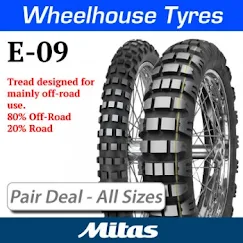
The Mitas E-09 Dakar was the only ones with feedback of 5k ish miles. I found the fronts, but the rear was only available in 150/70-18's and no 140's were due in before the new year. 

Several chats with mates and a bit of a poll online and I bought the pair with 150's from Wheelhouse Tyres in Coleshill, near Birmingham for £211. They fit fine, but the front was a bugger to get on, so I'll add mousse to the tubes in the hopes I don't get a puncture and have to change them in a high heat area. That would ensure some sweating and swearing I'm sure!

Whilst fitting the rear, I checked the corrosion on the rims. I've been meaning to buy new wheels for awhile now, but putting it off because of the £750 cost. It's too late now as there is a six week build wait and I haven't found a second hand one!
The corrosion is increasing, so I cleared the crap off and treated the wheels with a sealant, then spray painted the interior in the hopes that reducing air interaction then they'll last the trip. I'm carrying some metal putty and this will be a last resort thing to get me somewhere. Time will tell I guess. Whatever, this is their last outing.

I've added a sheepskin to the saddle. I've heard so much about their comfort on longer trips and a mate had a skin from one of his sheep going spare. So I cleaned it, shaped it and sent it to DP Leathers at Penrith. He made a saddle for my BSA B40 and did a lovely job. For this he sewed the straps on for me for £5, so now I get to try one for real!

After this lot, I serviced the bike, new filters, new brake fluid, new clutch fluid, DID 520 VX2 chain and sprockets, brake pads all round. Around £200 spent.

I've checked the linkage and wheel bearings. I've got spares of both in stock and will take the wheel bearings with me. The linkage bearings, I'll save for now and change when I get back. There is no play in them at the moment, so its a bit of a gamble as they've been in for awhile now and you need a press to get them out/in.
The wheel bearings were changed about 1000 miles ago, so should be good for this trip, but as they are easy to change, I'll carry spares. 
Head bearings appear to last for years on these bikes. But when I get back they'll be due a strip out and replacements installed as they will have done about 50+k miles by then.

One thing I've just been reading is about marine grease and how good its life span is. Desert stuff is different to a lot of travel in that sand gets into any grease and turns it into a grinding paste, so you need some grease to reduce wear and heat, but not so much that sand clogs it up and prematurely wears parts. So it's going to be a bit of a balance between cleaning/checking and riding time to preserve lifespans of parts.
Marine grease is a purchase for another time as I've left it too late now, but I like what I'm reading about it, so I may change from lithium to marine as a standard on all bearings.

That's it again for now. Next post will be on the road... Have a great festive season everyone.


Saturday, 17 December 2022

Sahara Bound: Luggage and Personal Prep

Prepping both myself and my bike for this trip has been a bit of a case of adapting and modifying existing stuff as well as adding in some new stuff. Let's start with the luggage and personal stuff, then move onto the actual bike in another post.

Luggage:
Panniers, I've gone for the Kriega OS18 kit which I've used before. It sits well on the bike and I can add things like fuel bottle holsters etc. For a top bag, I went with a cheaper version off Amazon, the Rhinowalk 20 litre bag has a load of attachment points and effectively copies the Kriega style but also has a few added features. The fabric quality is definitely not as good but at £32 per bag vs £99 per bag, it makes sense as I suspect, these will get trashed. I've also made some small bottle bags to attach to the rear of the Kriega's. These will hold inner tubes and the stove fuel bottle. Finally, I'll carry a drybag for food at the end of each day. This will be strapped into place as needed and when not in use, packed away out the way.

For the longer crossings, I've ended up choosing to use the Desert Fox 20 litre fuel bladder. It comes with a canvas overbag for protection and loads of attachment points. This raises my fuel range to roughly 500 miles, (38 litres x 13 LPM), the cost for that is the extra weight and also having to carry as another bag on the bike. To that end, I've made a cover to go over the top bags to stop them falling off. It's just an oblong piece of polyester/nylon with adjustable straps sewn on. The plan is to strap each bag down separately, then use this cover as a catch all. It's minor additional weight should be outweighed by its usefulness I hope!

Water is going to be an issue is certain parts, so I'm taking 2 x Black Diamond water bags and if needed I'll buy plastic bottles and strap them on. On the train line to Atar, there are huge water bladders stored for the local people, so they'll be useful. Heading into Southern Mauritania will require searching I suspect. In Morocco, every village has a water source, sometimes a spring, sometimes a shop plus the garages will have something.

Front bag. Lucy bought me an Enduristan Sandstorm 4ltr bag awhile ago, so this will go up front with things like charging kit, lip salve , glasses etc in it.

Navigation:
My go to navigation device has been a Garmin Montana for years now. So that is mounted onto the handlebars. The GPX routes I've planned for this trip will be on a laptop as will backups of maps etc. Just recently, I've found that the maps for Garmin units have become a little more difficult to find, so after spending a lot of evenings trying various versions out, I've finally gotten maps that work again.
As a hardware back up though, I've opted for a phone setup. So I have an old Samsung S7 phone with Maps.Me, Google Maps and as Maps.Me has been sold to a Korean investment company which is rapidly killing its functionality, I've also added its replacement 'Organic Maps' to the apps on the phone. 
Both of these are wired into the bike electrics for ease of use and the Garmin has both a rechargeable Lithium and can take 4 x AA batteries. 
Final part is to buy the Michelin paper maps for each country visited en-route, which I can then throw/give away when the time comes.
In Morocco and Mauritania, because these were French colonies in Victorian times and well visited now by French tourists, there are good road maps from Michelin available, however, there are not any modern detailed maps, such as the UK OS 1:50 or 1:25 maps outside of the Atlas.
I've also added some music and podcasts for some entertainment on the rare occasions I won't be riding.

Camping:
I'm taking a Terra Nova Voyager with me this time, it's free standing and I can use the inner without the outer for the hot deserts times. I'll also have a tarp, (made locally in Cumbria by Aiguille Equipment), for resting out of the sun or emergencies.
Cooking will be on my 30 year old MSR XGK stove. It uses petrol, so I then have a small amount of extra fuel if needed. Cooking pot will be a single non stick pan. I have packed a micro gas stove, purely as a back up and maybe to use in Spain / Portugal.
My sleeping bag will be a well used 1 season down bag from PHD alongside a 3/4 length Thermarest. I can use the tarp over this if it gets too cold for the bag, which I've done before at 5000m.

Clothing:
Bike kit will be my Adventure Spec Linesman Jacket, their Mongolia Trail Pants and their Atacama waterproof jacket. An Airoh Commander helmet, Forma Terra Enduro boots, Alpinestars Spartan gloves and Paradise Bikers Winter gloves. 
The Linesman jacket is too hot for the really hot places, so I've opted to remove its armour and take an old Forcefield armour top, which I can then wear under any big tee shirt. The Adv. Spec kit does the job nicely and all works together in a layered system, which I prefer. After around 40k miles now, its well proven for me!
I've used the Forma Adventure boots previously, which are comfy, but offer zero protection, the Terra's are much better, they are comfortable and you can stand up in them for hours.

Personal kit will be the usual for the UK, synthetic stuff including base layers, fleece top and trousers, but for the warmer weather, it'll be loose fitting long sleeve cotton tops. These clothes will be kept to an absolute minimum and/or I'll buy stuff in country if needed.

Toiletries will be very basic, soap, toothbrush/paste and a mini towel. Anything extra I need can be bought.

Medical:
As I'll be alone most of the time, my first aid kit is pretty basic. There are arguments for carrying bigger ones with more complex safety type stuff, but to be honest, most of it can be improvised in some way or another. The best thing is to be careful and avoid things, but after that, there are pain killers, basic wound covers to stem bleeding and, if I can get any in Morocco, antibiotics.
I'll also have my GHIC card and some medical repatriation insurance for the trip as a back up. But to be honest, my main 'serious rescue' is going to be other people passing and that might be down to luck because of the nature of the environment and this trip plan.

Spares/Repairs:
I've put together a tool kit specific to this bike, a set of spares and spares for the camp kit. There isn't much you can do for the electronics as they are mostly disposable, (which I disagree with wholeheartedly).

Camping/Clothing etc:
I've put in patches for the Thermarest, sleeping bag & tent. Some glue for fabric, some spare SR clips, 3 bar clips and G clips for the luggage setup. Then added in stove spares such as a jet, cleaners etc. 

Tools:
Spanners - open end/ring 6, 7, 8, 10, 11, 12, 13, 14, 15, 17, 19.
Plug spanner
Tyre pressure gauge
Specialized allen key folding tool
Halfords T bar
Sockets 3/8th - 6, 7, 8, 10, 12, 13.
Screw driver head to fit spinner handle - flat & cross head
Short metal bar - (For wheel bearings)
Tyre lever x 3 (Small x 1) + bead buddy
Wire cutters
Needle nosed pliers
Long Allen keys

Spare/Repair Stuff
Lots of cable ties - mounted to a fork stanchion
Some household electrical cable with some clips on either end to jump start bikes,
A mini hand pump,
A spare bike red light,
Some electrical tape,
A multi meter
Puncture patches and glue
A tow rope made from blue poly prop rope
Fuel hose for transferring fuel
Spare spark plugs
Wheel bearings - front & rear
Brake pads - front & rear
KTM micro fuel filter
O rings
Multiple bike fuses
Spare nuts & bolts, specific to the bike
Thread lock (red 223)
Spare tubes - front & rear
Spare brake/clutch levers
Spare oil filters
Spare air filter - (pre oiled)
Front sprocket & chain splitter tool + spare nut/lockring
Metal putty + radiator sealant

Ideally, I should have two clutch friction plates, one steel clutch plate, an injector and maybe a stepper motor as these all kill the bike if they die, but the extra weight is adding up and I'm starting to cut corners/save money.

One thing I have spent time and money on is a Bluetooth Reader for the fault codes on the bike. I settled on the ProScan Reader and after trying about 10 apps for the phone, I found the Garage Pro app worked with this on a subscription basis, so I bought the lifetime version for $22. It has already paid off, as I found a fault with a spark plug and fueling because of it. At least I'll know why I'm stuck if its bike related! 

Bike Weight:
I'm a few days away from departure now, so I've managed to have a play with the luggage set up and check out loading options as well as weights. The 2014 KTM bike weight is 150kg wet in standard form. I've shaved approximately 20kg off this bike, so 130kg. The luggage weighs 24kg in total. I've got to add to this 26 litres of petrol for the long sections and around 10 litres of water. 

One litre of petrol weighs 0.79kg and water is 1kg per litre, so that is another 30kg. (At least both of these are depreciating weights!). Food will also be added, so lets guess at 10kg for 4 days. So fully loaded I'll be  around 194kg just for the bike. That's a lot to haul out of a sand pit in 50 degrees!!

Paperwork:
Paperwork is mostly sorted en-route on this trip. In Spain and Portugal, entry will require a passport, standard UK vehicle papers, GHIC card and any insurances.
Morocco, the paperwork is done on the ferry, this allows a 90 day visa with a vehicle and you buy a month worth of insurance for 95 euros. 
Mauritania is pretty much the same. You buy your entry visa and insurance at the border in Euros.
In both of these countries, you need to carry a 'Fishe', which is a piece of paper with all of your and your vehicle details on it. These then get handed over at the many military checkpoints and ease the life of the guards on duty, which means you pass through quicker.
I'll carry back ups of these on the laptop and on a USB stick to be sure, plus back them up somewhere. Online access will be restricted to my laptop and an in country sim card paired to the laptop. This helps with online security and as an emergency contact possibility.

Research Info:
Most of my knowledge for this trip has come from online sources, my personal knowledge and some notable desert explorers.
Social Media has a wealth of Facebook groups such as West African Overlanding, Horizons Unlimited & Overlanding West Africa and Morocco, these contain many valuable updates and insights.
Chris Scott has toured all over the Sahara and details much of his travels and local knowledge on his website. His book 'Sahara Overland' has helped me to plan many parts of this trip.
Austin Vince and a group of friends traveled some of this route in 2013. I watched his film Mondo Sahara a few times and he helped me find the train line I wanted to ride in Morocco.
Dave Lomax, from Adventure Spec, helped me with the Eye of Africa  and heading south in Mauritania.

My neighbour, who is a well travelled 80+ year old, has given me two books to read before I go, the first is about the original crossing of the Empty Quarter in the Middle East, 'Arabian Sands' by Wilfred Thesiger, and the second is about a university group who visited the Berber villages in Morocco in 1955. 'Berber Village' by Bryan Clarke. I have friends in the Berber villages of Morocco, so it'll be interesting to see the differences between my knowledge and their experiences.

'Arabian Sands' reminds of another 1800 mile journey I took across West Antarctica with 3 colleagues in 2013, where our main source of info, outside of modern satellite mapping, was a book called 'Across West Antarctica' by John Pirrit. I'm not sure I'll get time to read this book before I go, but it does look a good read.


So for now, that's where I'm at. I'll do a post about the bike setup and costs for this as it has been a bit more intensive/expensive than first thought!


Saturday, 26 November 2022

Sahara 2023

For a long time now, I've been wanting to visit Morocco and Mauritania to ride around the Sahara. So for the last couple of months, I've been doing some planning. My work commitments will all be met by Christmas 2022, so I've decided to take three months off and finally go do the trip that's been in my head. I can feel the Desert calling to me!

The rough plan is; 
Ride down through Spain & Portugal on some of the Trans Euro Trail, (TET) and the Adventure Country Tracks, (ACT), then cross into Morocco, roughly follow the Algerian border down to the Anti Atlas on old Paris/Dakar routes and eventually enter into Mauritania via the disputed lands of Western Sahara. 

Once I've given the bike a clean up and fettle around there, I'll head east towards Atar and the Eye of Africa, then south to Nema and slowly make my way back north. This should take me some really remote parts of the Sahara and also get me to many of the off the beaten track villages and towns.

I really wanted to do a loop back up through Algeria, but I don't have enough time now to sort the visa and the necessary invitation letter, so I've shelved that section for another time. I may well go in a 4x4 for that too as its easier to travel and camp etc in these areas with one of those.

There are quite a few logistical challenges to sort out. Fuel and tyres are the main ones. Morocco is pretty well set up for travelling, but Mauritania is not. Diesel is the main fuel used in the country, so getting petrol presents an issue. There will be several sections of 4 - 500 mile distances, so alongside my current bike range of 250 miles, I'm taking a 20 litre fuel bladder, which will be strapped onto my bike alongside water bags. This is going to add a lot of weight to the bike!

There are no motorbike tyres available in Mauritania and the last place to get any tyres will be either Ourzazate or Zagora in southern Morocco. That means I need around 5000 miles minimum out of a set of tyres. The only options are the Desert race tyres from the likes of Mitas, Motoz and Dunlop. There are no tyres on the market that will do 10k miles on the terrain involved, but so long as I get back to Spain, I can sort that out later.

If the bike or myself have a significant issue or breakdown, it's not going to be easy to get it sorted, Morocco may be easier, but Mauritania will depend upon others passing and helping out.

Things like vehicle insurance, visas etc are dealt with at the border to both these countries. I'll need to get my International Driving License and some form of suitable travel insurance, although medical issues are the same as any other third world country, find a clinic if you can, if not, deal with it yourself. 

Both countries use Arabic, French and some English, alongside whatever local language, such as Berber etc. So communication for me will be English and French. 

After watching Austin Vince's film, Mondo Sahara, a few years ago, I was fascinated by the ride along the old 600 gauge railway coming down through Morocco. Since then, I've spent a lot of hours trying to find that route and convert it to a GPX file. Finally, as time is now coming to an end for the trip planning phase, I resorted to contacting Austin Vince direct and asking for his help. He pointed me at a bridge on the route and after that I spent a couple of hours on Google Maps following it and marking it with waypoints into Garmin's Basecamp. So I now have that route and will either ride it heading south or coming back north.

Lots of other parts of logistics are going to come into play. The weather heading south from the UK will be rubbish, cold, wet and maybe icy. I could get a ferry south from Portsmouth to Bilbao/Santander. Its really expensive at over £500 one way, but it will save 1000 miles on my tyres and my comfort, so that is looking likely. I'll need tyres for the return trip though for sure. 

Luggage wise, I'm taking my Kriega luggage set up a tent, the usual camping kit, a change of clothes etc, a range of bike spares, which will have to include wheel bearings and other wearable parts. A new DID chain and the Ironman sprockets should last well, although I'm taking a spare front sprocket to be on the safe side. Air filters are an issue in the desert, fine sand can easily knacker an engine, so apparently, fine mesh women's tights are cheap and easy to buy, they do a great job and take seconds to change each morning! That's a conversation to be had!! ;-)

For the navigation side of things, I'll have two systems. My Garmin Montana 600, which is my preferred GPS system and a Samsung phone with Maps.Me/Google Maps loaded onto it. Both have a 12v power set up, but both also have an internal rechargeable battery, just in case.

Mauritania has virtually no mobile phone signal outside of the coastal areas, Morocco is better set up, but in the southern Anti Atlas, there is little coverage. So  for the most part, its no comms, so no worries!

I can't decide whether to buy a separate film camera for the trip, or just not bother with any film etc and go with pics. Films show more, but its a lot of faff to keep the batteries charged and the equipment protected. That's both extra space and weight to be sorted out. 

That's about where I've got too at the moment. The routes are almost finalised, the kit is sorted, some spares on order. Next up is ferry booking and find some new tyres. The bike is about ready, so finish my work commitments and then get riding!